What the NSW Inquiry into Public Toilets Means for Councils

In 2025, the NSW Parliament published 22 recommendations on public toilet design, accessibility, and maintenance. The findings apply nationally and signal a shift toward single-use cubicles, Changing Places provision, CPTED-compliant design, and low-maintenance materials. Councils acting on these recommendations now in any state will be ahead of the curve when the NCC 2025 edition formalises these standards nationally.
Key Takeaways
- Changing Places facilities are the most urgent unmet need and Commonwealth funding covers up to 100% for beach and national park locations
- Single-use cubicles with internal amenities are now the preferred design over multi-stall facilities
- Steel and aluminium construction directly addresses the maintenance burden the inquiry highlights as a key council concern
- CPTED compliance is growing in importance — prefabricated single-cubicle and multi-building designs are inherently aligned
- These are national trends, not just NSW, the NCC 2025 edition will apply across all states and territories
In October 2025, the NSW upper house delivered a massive 190-page report into the state of public toilets. The inquiry, chaired by Albury-based Greens MP Amanda Cohn, was tasked with investigating the “provision, design, accessibility and inclusivity of public toilets across New South Wales”, and examining best practice in provision and maintenance.
The inquiry received 71 submissions and heard from 60 witnesses over the course of five public hearings. The NSW Government tabled its own response to the inquiry’s 6 key findings and 22 recommendations in January 2026.
Overall, the report concludes that the current regulatory framework for public toilets is not fit for purpose. It states that the effects of inadequate provision and lack of access are significant and place disproportionate costs upon some segments of the Australian community.
The NSW Government’s response broadly defers the problem onto local councils while acknowledging the fundamental importance of accessible and well-designed public toilet facilities.
With that as contextual framework, here’s our distillation of the key outcomes of the inquiry and the NSW government response, and the downstream implications for council officers, landscape architects, and project managers.

"Let's Fix Public Toilets" campaign by Greens MP Amanda Cohn, who chaired the NSW Parliamentary Inquiry into Public Toilets
Changing Places Toilets: A Critical, Unmet Need
The inquiry report identifies Changing Places facilities as one of the most urgent and undersupplied needs despite the fact that ‘Accessible Adult Change Facilities’ have been an NCC-specified requirement for all public building design since May 2019.
Changing Places is an Australia-wide initiative to provide accessible public toilets and change rooms for people with high support needs. They are larger than standard accessible toilets and have extra features to meet the needs of people with disability and their carers.
There are currently only 46 Changing Places amenities in New South Wales. The report notes that Victoria (where Changing Places originated) has 153 and Western Australia has 52, while Queensland’s City of Moreton Bay is developing Australia’s first Changing Places Network Plan. They primarily (though not exclusively) exist for the more-than-200,000 Australians with profound disabilities whose toileting needs are not met by standard accessible toilets.
Inquiry submissions note that while the national toilet map identifies where these toilets are, it does not show availability or cleanliness. Nor, for planners does it reveal whether there are enough for the population, maintenance state, design and other uses of public toilets.
The inquiry recommended the NSW government perform an accessibility audit of existing public toilets, including Changing Places facilities, to identify gaps in provision. Further, it recommended the state government develop a funding model to support local governments to upgrade public toilet facilities, including Changing Places funding.
Although the NSW government response chose to not mandate audits, it accepts the importance of accessible, inclusive and well-designed public toilets. We consequently believe many councils are likely to self-assess the adequacy of their toilet amenities in light of a growing recognition that Changing Places facilities are needed to allow people with complex physical needs to participate in public life.
Additionally, although the report notes that a new standalone Changing Places facility can cost between $180,000 and $230,000 (or $120k to $150k for a retrofit), Commonwealth funding that currently operates across all states and territories will cover up to 50% of the build cost. For Changing Places facilities located at inclusive beaches (including river beaches) and national parks, the Commonwealth will fund up to 100% of eligible costs under the Accessible Australia Initiative.

Community Prefers Single-Use Cubicles to Multi-Stall?
Inquiry submissions from stakeholders and experts indicate that
The community-at-large now expects greater privacy, safety, and inclusivity from public toilet facilities. They perceive this benefits a broad range of people, including parents of young children menstruating women, people with neurodiversity and other “hidden” disabilities, or people who are transgender or gender diverse.
As a result, the Inquiry recommended that single-use cubicles ‘should, where feasible and practical, be preferred over multi-stall public toilets’, and the NSW Government should mandate minimum standards to promote single-use cubicles via planning instruments.
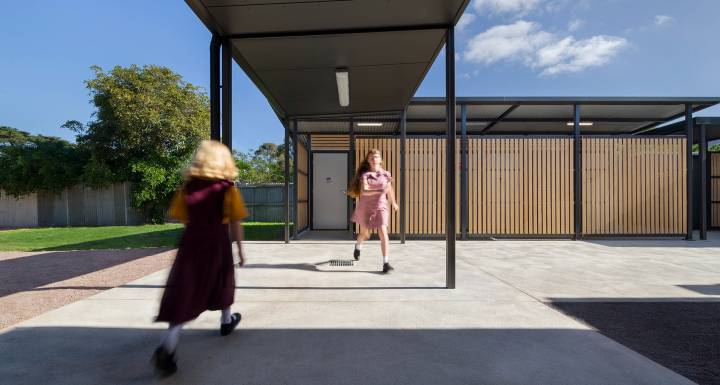
We know from experience that projects comprising purpose-built prefabricated toilet buildings of individual self-contained cubicles can be completed with an accelerated timeline that directly translates into cost savings, smaller labour requirements and lower on-site overheads for councils.
As a side benefit, individual cubicles also closely align with the demands of CPTED principles (eg: enable natural surveillance, eliminate hidden corners) and thus help combat vandalism and undesirable activity.

NCC moves toward affirming all-gender toilet facilities?
Similarly, the inquiry recommends mandating all-gender single-use cubicles. Depending on the site and cost, this could be either instead of or in addition to gendered facilities but must be in addition to accessible toilets.
The NSW Government noted in its response that it has already supported Federal amendments to the National Construction Code 2025 (NCC) to provide all-gender toilets in public buildings. Therefore, we believe that this is something council planners should keep in mind in their planning. Moreover, good public toilet facility manufacturers already have customisable individual cubicle designs that are set up to support this sort of configuration.
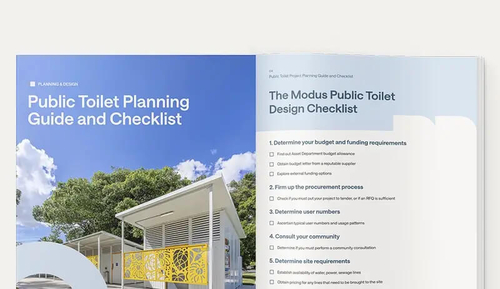
Download the NSW Inquiry Checklist
A practical planning checklist based on the 22 recommendations from the NSW Parliamentary Inquiry into Public Toilets. Use it to assess whether your next project is aligned with where the sector is heading.

Using steel and aluminium to get out from under the maintenance burden?
The Inquiry highlighted the substantial maintenance burden that public toilet facilities on councils.
In one submission, Blacktown City Council said that ‘we currently manage 218 public toilets through the City, with 45 of these open 7 days a week…Our annual operational expenditure for the operational cleaning services, consumables, maintenance and sanitary services of the public toilets network is in excess of $15 million, which includes a full-time team of 6 staff and 3 vehicles to service these facilities daily’.
In another, Bega Shire Council identified that it costs, on average, approximately $13,000 to clean and maintain a typical public toilet building each year.
Local Government NSW says this impost is why public toilet designs must function improve the efficiency of cleaning and servicing. Materials used in the construction of public toilets need to allow for easy cleaning, resistance to vandalism and be durable while still being functional and welcoming.
We think that this will only accelerate the trend for council procurement teams and asset managers to spec toilet facilities that reduce lifecycle maintenance cost. The good news is that steel and aluminium construction directly addresses this. It is easier to clean, graffiti-resistant, and delivers lower overall lifecycle cost.

CPTED only growing in importance?
Crime Prevention Through Environmental Design (CPTED) is referenced throughout the Inquiry as the primary safety framework for public toilet design. Some submissions noted that toilets unable to meet these standards must close at night — often when they are most needed by citizens.
In summary, when determining the design and format of public toilet facilities, CPTED states the following principles must be taken into consideration: natural surveillance, natural access control, territorial reinforcement, and maintenance/management.
Further, the NSW Department of Planning, Housing and Infrastructure advised the Inquiry that the department is currently considering adding a fifth principle to the CPTED guidelines.
Consequently, we believe councils and landscape architects will increasingly need to demonstrate CPTED compliance in planning applications.
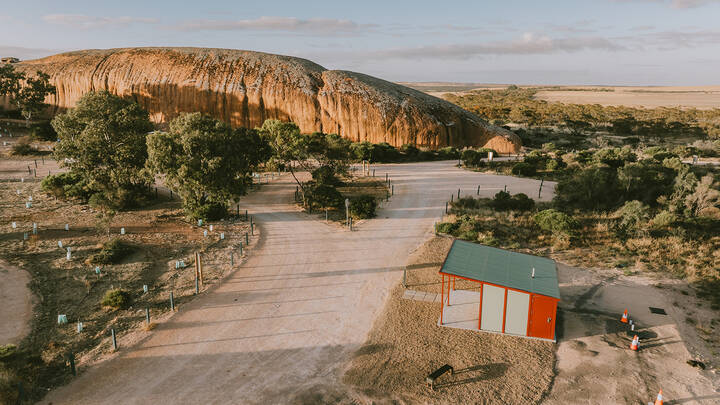
Prefabricated single-cubicle toilet designs and multi-building configurations that use vandal-resistant materials are inherently aligned with CPTED principles through the provision of clear sightlines, natural surveillance, and unobstructed entry. Multi-building layouts, where individual cubicles are separated into smaller grouped structures across a site, further enhance natural surveillance by eliminating hidden corridors and recessed areas common in traditional toilet block designs.

Turnkey multi-use solutions solve more problems
The Inquiry’s report highlights two further things.
First, there continues to be a lack of coordination between the design of public toilet amenities, and their procurement, installation, and maintenance. Second, there is a clear trend toward building amenities that combine toilets, change rooms, Changing Places, and storerooms in a single unit.
The desire of the community for the latter points to flexible, turnkey floorplans as the solution for the former. If councils can start with a base module and work with a single supplier to add options that suit the requirements of their site and community, everyone benefits.

A final takeaway for the direction of Australian public toilet design
These two reports constitute the single-most-comprehensive examination of public toilet provision to date. Our estimation is that the findings will set the benchmark for what councils around Australia should focus on when it comes to public toilet design and provision.
That is to say: the themes and recommendations are not state-specific; they reflect a national direction of travel.
Readers should keep in mind that the National Construction Code 2025 edition is due for release this year. It will apply nationally and we expect it to incorporate several of the design principles this inquiry raised.
Councils in QLD, VIC, WA, and elsewhere, that act on these recommendations now will find themselves ahead of the curve when similar standards are formalised nationally.