5 Grants to Fund Public Toilet Building Projects in 2026

The start of a new financial year is when most councils lock in their capital works for the next twelve months. If a new public toilet block, a Changing Places facility or an amenity building is on that list, the question is usually the same: how do we fund it?
The good news is that the funding cycle for 2026-27 is active. Several programs can help cover the cost of a new or upgraded amenity building, and one of the largest is about to open new rounds. This article runs through what is worth knowing, and how to make sure your project is in the best position to secure it.
A quick note before we start: funding details and eligibility change between states and rounds, so treat this as a starting point and confirm the current details before applying.
1. Accessible Australia Initiative (Changing Places)
If an accessible facility is on your radar, Changing Places funding is the most direct path to getting one built. These facilities go well beyond a standard accessible toilet, providing the space, ceiling hoist and adult change table that people with high support needs require. The Australian Government helps fund them, and for facilities at inclusive beaches or national parks, it can cover the full cost.
- What it funds: Accessible Changing Places facilities
- Who applies: Councils, through their state or territory government (not directly to the Commonwealth)
- Funding: 100% for inclusive beaches, national parks and portable facilities, or 50% for fixed facilities and play spaces, with a typical facility costing around $230,000
- Status: Ongoing in annual stages through to 2027-28, with all local government areas eligible
Because the funding depends on accreditation, the starting point is a building designed to meet the Changing Places Design Specification. Modus designs and delivers fully compliant Changing Places facilities across Australia, so the building itself is one less thing to work out.

Your Changing Places Roadmap
Changing Places projects come with funding, engineering, and accreditation hurdles. Our guide walks councils and project managers through each step, start to finish.
2. Heavy Vehicle Rest Area Initiative
If you manage roads or rest areas, the Heavy Vehicle Rest Area initiative can fund the amenity building that makes a roadside rest stop usable: the toilet block, shelter and associated facilities. It sits within the Safer Local Roads and Infrastructure Program (SLRIP) and is backed by $140 million over ten years to 2031-32.
- What it funds: Toilet blocks and amenities at heavy vehicle rest areas
- Who applies: Councils and state or territory governments, nationally
- Funding: Up to 80% for regional and remote councils, up to 50% for urban, capped at $5 million per project
- Status: Open year round, assessed in tranches up to three times a year, so there is no single deadline to miss
Because the Department rarely accepts late evidence once a tranche closes, your first submission needs to be your strongest. That means having the rest area amenity building scoped, specified and costed before you apply.

Your HVRA Funding Roadmap
HVRA funding is assessed in tranches, so your first submission needs to be your strongest. Our guide and checklist map out the exact evidence pack you need to secure up to $5M in funding.
3. Growing Regions and Thriving Suburbs (community infrastructure)
These two federal programs fund community infrastructure more broadly. Growing Regions covers regional and rural areas, and Thriving Suburbs covers urban and suburban areas. A new or upgraded public toilet or amenity building is exactly the kind of inclusion that rounds out a park, reserve or community precinct upgrade, and it is fundable as part of these projects.
- What it funds: Community infrastructure, including amenity buildings within larger projects
- Who applies: Councils and not-for-profits (Growing Regions for regional and rural, Thriving Suburbs for urban and suburban)
- Funding: Grants up to $15 million, covering up to half of eligible project costs
- Status: New rounds committed ($750 million in the 2026-27 Federal Budget), with dates not yet announced
That gap is the opportunity. Councils know more money is coming but cannot apply yet, which makes right now the ideal time to get your project scoped and build-ready. These programs reward projects that are well planned and ready to go, so the work you do now is what puts you in the first round rather than waiting for the next.

4. Community Sporting and Recreation Facilities Fund (CSRFF, WA)
If you are in Western Australia, the Community Sporting and Recreation Facilities Fund (CSRFF) is the established route to funding an amenity building at a sport or recreation site. Change rooms and ablutions are specifically named among the facilities it supports, which makes it a direct fit for a new or upgraded amenity block. It now sits under the WA Government's PlayOn WA: 2030 by 2030 initiative, and the timing of the next rounds is currently under review.
- What it funds: Change rooms and ablutions at sport and recreation sites
- Who applies: WA councils and incorporated sport, recreation or community organisations
- Funding: Historically up to 50% of project cost for smaller projects, with larger projects assessed through a forward planning round
- Status: Next round timing is under review as part of PlayOn WA, so there is no confirmed open round at the moment
For now, this is one to watch rather than apply for today. The smart move is to get your amenity building scoped, designed and costed in advance, so that when a round opens you are ready to move while others are still getting started. It is worth contacting your local department office to confirm where things stand before you plan around it.

A build-ready project wins funding
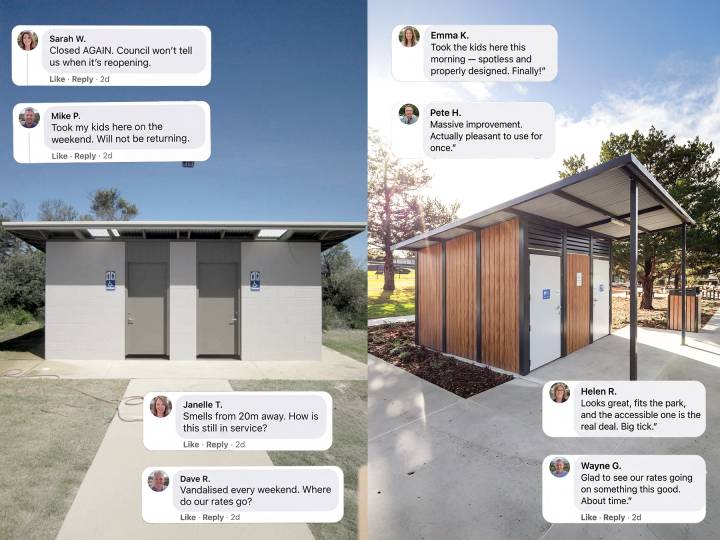
Across every one of these programs, the same theme holds: the projects that secure funding are the ones that are already well planned. A clear scope, a compliant design and realistic costs are what turn a good idea into a fundable one.
That is where Modus comes in. We give you everything you need to make your project a success: budget costings you can put straight into a submission, 3D renders and floorplans that show assessors exactly what you are building, clear detail on the grant and what it requires, and a hand pulling the application together. The building itself, designed to the relevant standards and fully costed, becomes the backbone of a strong submission.
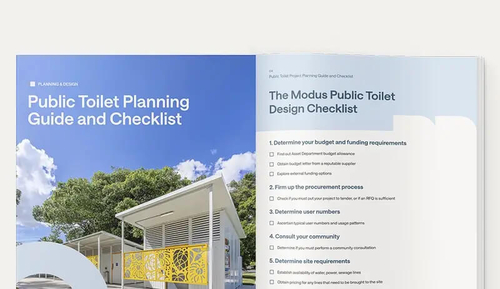
Not sure where to start? Our Public Toilet Planning Guide and Checklist walks through every stage of an amenity building project, from site and access to compliance, finishes and budget, so you can scope something that stands up to a funding application.
Download the Complete Guide and Checklist
Ensure your public toilet project is well-planned, accessible, and built to last. Get the key steps and expert insights in one easy-to-use guide.

Thinking about applying? Let's talk
If you have any questions, reach out below or book a time with one of our project consultants. If you are considering applying for a grant to fund a public toilet or amenity building, or the open space furniture and shelters around it, this is the best next step you can take. The consultation is complimentary, we will help you get everything in order, and it will set your project up for success.