6 Grants to Fund Public Toilet Building Projects in 2026

The start of a new financial year is when most councils lock in their capital works for the next twelve months. If a new public toilet block, a Changing Places facility or an amenity building is on that list, the question is usually the same: how do we fund it?
The good news is that the funding cycle for 2026-27 is active. Several programs can help cover the cost of a new or upgraded amenity building, and one of the largest is about to open new rounds. This article runs through what is worth knowing, and how to make sure your project is in the best position to secure it.
A quick note before we start: funding details and eligibility change between states and rounds, so treat this as a starting point and confirm the current details before applying.
1. Accessible Australia Initiative (Changing Places)
If an accessible facility is on your radar, Changing Places funding is the most direct path to getting one built. These facilities go well beyond a standard accessible toilet, providing the space, ceiling hoist and adult change table that people with high support needs require. The Australian Government funds them through the Accessible Australia initiative, covering half the build cost of a fixed facility.
- What it funds: Accessible Changing Places facilities. The same initiative also funds inclusive beach and national park amenities, under separate and much smaller caps
- Who applies: Councils, through their state or territory government, not directly to the Commonwealth. Every local government area is eligible, including those that already have accessible infrastructure
- Funding: 50% of the build cost of a fixed facility, up to a $250,000 build cost, so around $125,000 from the Commonwealth
- Status: Running in tranches through to 2027-28. Each state and territory opens its own application window, so check where yours is up to rather than assuming a round is open
Because the funding depends on accreditation, the starting point is a building designed to meet the Changing Places Design Specification. Modus designs and delivers fully compliant Changing Places facilities across Australia, so the building itself is one less thing to work out.

Your Changing Places Roadmap
Changing Places projects come with funding, engineering, and accreditation hurdles. Our guide walks councils and project managers through each step, start to finish.
2. Heavy Vehicle Rest Area Initiative (SLRIP)
If you manage roads or rest areas, the Heavy Vehicle Rest Area initiative can fund the amenity building that makes a roadside rest stop usable: the toilet block, shelter and associated facilities. It sits within the heavy vehicle facilities stream of the Safer Local Roads and Infrastructure Program (SLRIP), which receives at least $200 million every year on an ongoing basis.
- What it funds: Toilet blocks and amenities at heavy vehicle rest areas. Every project must also deliver a road safety outcome, so fatigue management on its own is not enough
- Who applies: Councils and state or territory governments, nationally
- Funding: Councils can receive up to 90% of project costs in remote areas, 80% in regional areas and 50% in urban areas. State and territory governments can receive up to 50% in all locations. Capped at $5 million per project
- Status: The current round closes 5:00pm (AEDT) Sunday 31 January 2027
Once a round closes, new or additional information generally will not be considered, so your first submission needs to be your final one. Your co-contribution also has to be secured at the point you submit, and in-kind contributions cannot be counted. That means having the rest area amenity building scoped, specified and costed before you apply.

Your HVRA Funding Roadmap
HVRA funding is assessed in tranches, so your first submission needs to be your strongest. Our guide and checklist map out the exact evidence pack you need to secure up to $5M in funding.
3. Growing Regions and Thriving Suburbs (community infrastructure)
These two federal programs fund community infrastructure more broadly. Growing Regions covers regional and rural areas, and Thriving Suburbs covers urban and suburban areas. A new or upgraded public toilet or amenity building is exactly the kind of inclusion that rounds out a park, reserve or community precinct upgrade, and it is fundable as part of these projects.
- What it funds: Community infrastructure capital works, including amenity buildings within larger projects
- Who applies: Councils and incorporated not-for-profits. Thriving Suburbs covers projects inside the ABS Greater Capital City Statistical Areas, and Growing Regions covers everything outside them
- Funding: Grants from $250,000 to $15 million. Co-funding rates will be set in the round guidelines, which have not yet been published
- Status: $750 million committed over three years in the 2026-27 Federal Budget. Both programs are currently listed as forecast opportunities, with dates still to come
That gap is the opportunity. Councils know more money is coming but cannot apply yet, which makes right now the ideal time to get your project scoped and build-ready. These programs reward projects that are well planned and ready to go, so the work you do now is what puts you in the first round rather than waiting for the next.
4. Community Sporting and Recreation Facilities Fund (CSRFF, WA)
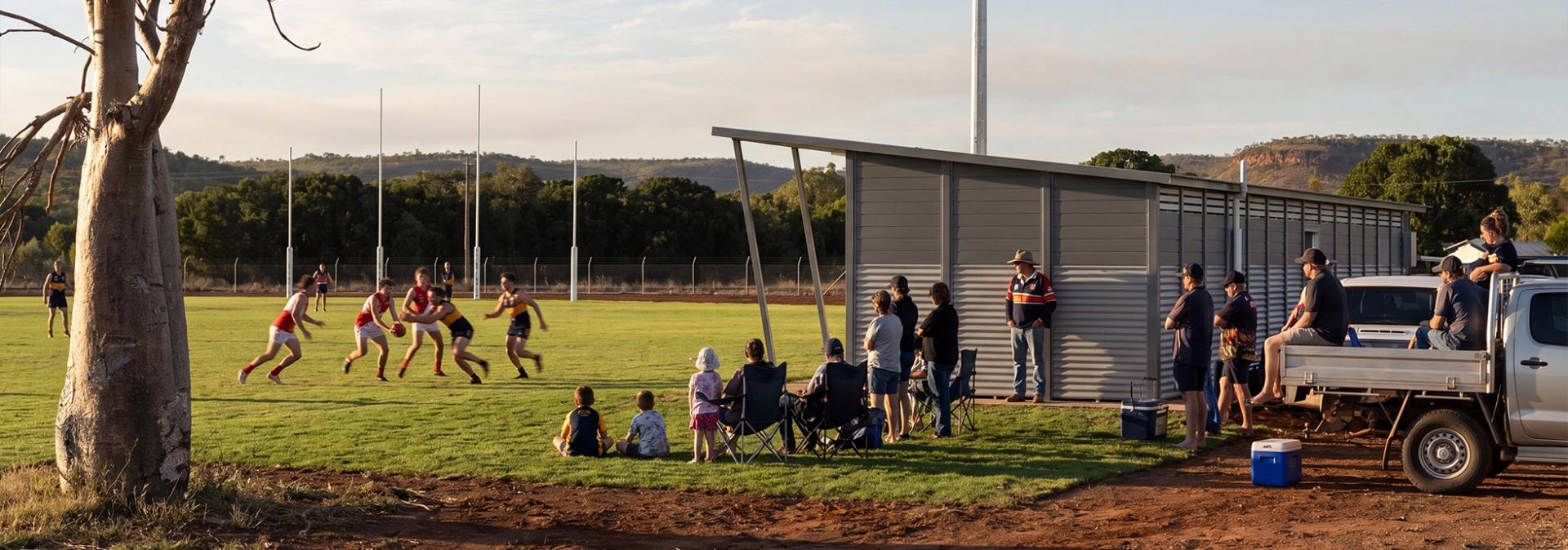
If you are in Western Australia, the Community Sporting and Recreation Facilities Fund (CSRFF) is the established route to funding an amenity building at a sport or recreation site. Change rooms and ablutions are specifically named among the facilities it supports, which makes it a direct fit for a new or upgraded amenity block. It now sits under the WA Government's PlayOn WA: 2030 by 2030 initiative.
- What it funds: Change rooms and ablutions at sport and recreation sites
- Who applies: WA councils and incorporated sport, recreation or community organisations
- Funding: Historically up to 50% of project cost. Small grants cover projects up to $500,000, with anything larger assessed through a forward planning round
- Status: No new round has opened since the 2026-27 forward planning round closed on 30 September 2025. Future round timing has not been confirmed
For now, this is one to watch rather than apply for today. The smart move is to get your amenity building scoped, designed and costed in advance, so that when a round opens you are ready to move while others are still getting started. It is worth contacting the Department of Creative Industries, Tourism and Sport, formerly DLGSC, to confirm where things stand before you plan around it.
5. Better Open Spaces Program (NSW)
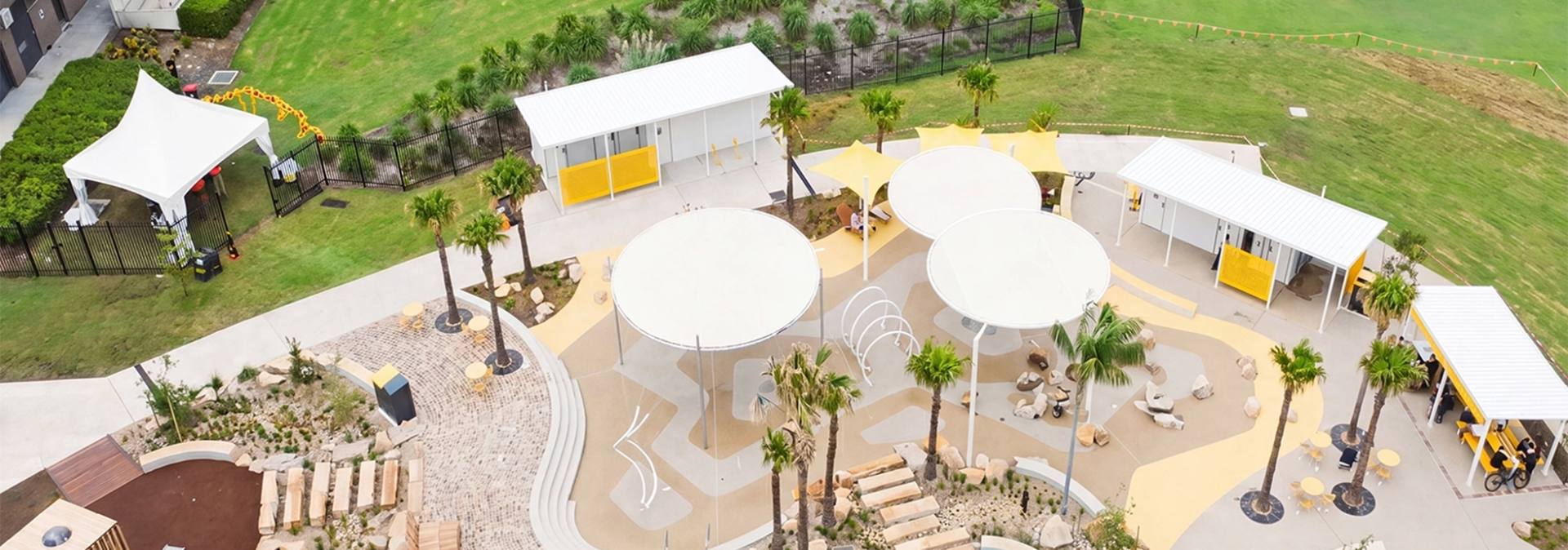
If you are a council in one of New South Wales' high housing-growth areas, the Better Open Spaces Program funds upgrades to a park, sports field or town square, along with the amenities and shelters that make them usable. It is a $40 million NSW Government program delivered over two rounds. Round 1 closed on 31 August 2026, and Round 2 works differently.
- What it funds: Upgrades to parks and sports fields including new and improved amenities, improvements to swim sites, and public domain works in town squares and civic plazas, along with picnic shelters, BBQ facilities and shade structures
- Who applies: The 53 eligible councils, being the 43 LGAs with an individual housing target plus the 10 highest-growth regional LGAs. Round 2 is a closed round, so councils cannot apply directly. The Minister nominates projects and the Department then invites those councils to apply
- Funding: Grants of $150,000 to $2 million, one nominated project per council, from a $4 million Round 2 pool. Matched funding is not required, though a co-contribution can stretch what the project delivers
- Status: Round 2 opened in October 2026 and runs for six weeks, with outcomes expected in December 2026. These dates are indicative and confirmed by the Department once the nomination process is complete. Funded projects must be delivered between 1 March 2027 and 30 June 2029
Because Round 2 runs on nomination rather than open application, the lever a council has is making representations to the Minister's office about a project worth nominating. Nominated projects are then assessed on value for money, community benefit and deliverability, which makes a construction-ready project the difference between a nomination that converts and one that stalls. Modus can scope, design and cost the amenity building, shelters and furniture as a ready-to-deliver package that slots straight into a submission.
6. Capital Grants Program (non-government schools)
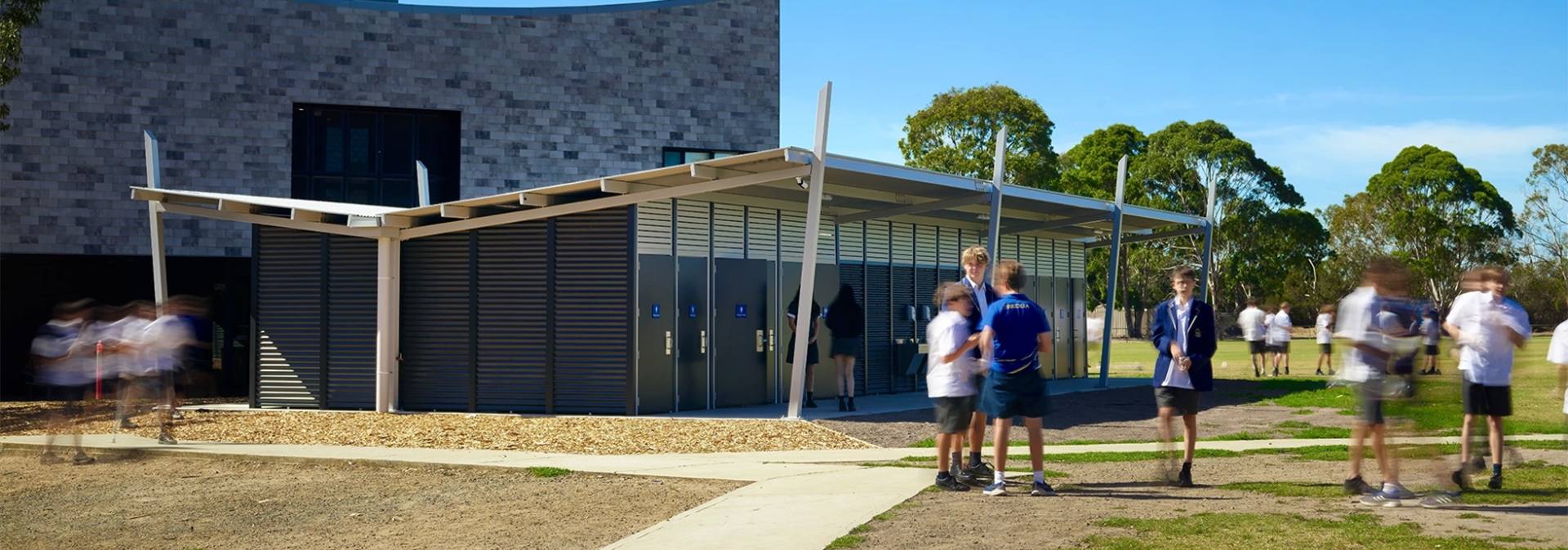
Public toilet funding is not only a council question. Non-government schools can access the Australian Government's Capital Grants Program, which funds school infrastructure including new, extended and refurbished buildings. A replacement amenity block or an accessible facility for students with high support needs both sit inside its scope.
- What it funds: Building, extending or refurbishing school buildings and facilities, site preparation, water and electrical services, and capital assistance for students with disabilities
- Who applies: Non-government primary and secondary schools, through their state or territory Block Grant Authority, not directly to the Commonwealth. Government schools are funded through state capital allocations instead
- Funding: Allocations vary by state and by round. Schools must demonstrate financial need and financial viability, and a school contribution is expected
- Status: Each Block Grant Authority runs its own calendar. In Western Australia, expressions of interest for the 2027 round reopen in November 2026, with applications due to AISWA by the end of March 2027
The process is long, and that is the part worth planning around. A WA school lodging an expression of interest now would be notified in December 2027 and able to start on site from January 2028. Scoping and costing the building belongs at the front of that process, not after an approval lands. Modus works with schools the same way it works with councils: a scoped, specified and costed building that a funding submission can be built around.
A build-ready project wins funding
Across every one of these programs, the same theme holds: the projects that secure funding are the ones that are already well planned. A clear scope, a compliant design and realistic costs are what turn a good idea into a fundable one.
That is where Modus comes in. We give you everything you need to make your project a success: budget costings you can put straight into a submission, 3D renders and floorplans that show assessors exactly what you are building, clear detail on the grant and what it requires, and a hand pulling the application together. The building itself, designed to the relevant standards and fully costed, becomes the backbone of a strong submission.
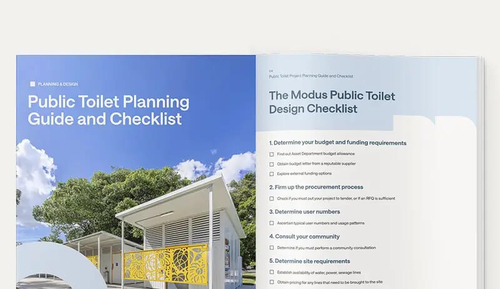
Not sure where to start? Our Public Toilet Planning Guide and Checklist walks through every stage of an amenity building project, from site and access to compliance, finishes and budget, so you can scope something that stands up to a funding application.
Download the Complete Guide and Checklist
Ensure your public toilet project is well-planned, accessible, and built to last. Get the key steps and expert insights in one easy-to-use guide.

Thinking about applying? Let's talk
If you have any questions, reach out below or book a time with one of our project consultants. If you are considering applying for a grant to fund a public toilet or amenity building, or the open space furniture and shelters around it, this is the best next step you can take. The consultation is complimentary, we will help you get everything in order, and it will set your project up for success.