Creating Coastal Resilience: The 5 Critical Mistakes When Designing Beachside Public Toilets

Designers sometimes underestimate how coastal salt spray, humidity, sand, and intense UV radiation is able to begin degrading public toilet facilities within months. Mistakes about location and siting, assumptions of material durability, mis-specified fixings and hardware, inadequate flooring and draining, plus insufficient attention to maintenance are five things that can contribute to rapid corrosion and premature facility failure.
Key Takeaways
- Asset managers, project managers, and landscape architects must focus on resilience when they design toilet buildings and amenity blocks for coastal locations.
- Locate buildings away from breaking surf to minimise direct salt spray exposure.
- Avoid unsuitable materials such as untreated timber, and steel that is not fully hot-dip galvanised.
- Brushed concrete flooring is a trap for sand; epoxy surfacing performs better.
- Don't overlook proper drainage, high-pressure wash-down provisions, and a coastal-specific maintenance plan.
Following these general rules avoids expensive fixes, prolongs lifespan, and keeps facilities usable for beachgoers.
1. Are you locating your public toilet block poorly?
The biggest mistake happens before materials are even chosen: placement. Never locate your building too close to breaking surf. Ocean views might be desirable and it might seem more convenient for people, but a toilet block that's too close to the water will be subject to saltwater spray, accelerating corrosion (or rot in the case of timber) regardless of the material used.
So, what's the fix?
Site your building at least 50 to 100 meters away from breaking surf. This significantly cuts the salt load that hits the toilet block. Don't put amenities on breakwalls or structures designed to be submerged. Even boats require constant scrubbing to get rid of salt and maintain their condition and good appearance; no building on land is going to ever receive a similar level of upkeep.

2. Are you making the wrong assumption about material durability (aka the timber trap)?
People tend to think that timber is a safer choice for coastal areas because (unlike steel) it does not corrode. But, while timber avoids rust, it introduces big maintenance liabilities. In coastal conditions, timber degrades, warps, and requires constant re-sealing or painting to withstand the elements.
So, what's the fix?
Steel, when specified correctly for public modular washroom, offers superior longevity with fewer maintenance needs. However, not all steel is created equal. Using pre-galvanised steel and failing to protect your welds are common mistakes. Instead, use steels that is hot-dip galvanised after welding. This ensures vulnerable welds are fully protected and provides maximum corrosion resistance.
Exposed steel should be treated with two-pac epoxy paint, and cladding should be Colorbond Ultra or aluminium toilet components, since aluminium performs exceptionally well in saline environments.

3. Are you under-specifying your fixings and hardware?
You can have the best cladding in the world, but if the bolts holding it together rust, the toilet amenity fails. Don't make the mistake of using standard fixings instead of hardware that's robust enough for marine conditions. In a coastal zone, standard fixings will corrode quickly, first damaging your aesthetic look with unsightly rust stains, then affecting the building's structural integrity.
So, what's the fix?
All fixings, locks, hinges, and hardware in your toilet block must be Marine Grade 316 Stainless Steel or have a Grade 4 coating. Some internal components might be able to use the more common 304 grade stainless steel, but every external and high-exposure element must be made from 316 grade to resist the corrosive attack of direct exposure to a salt-air environment. We back this up with real-world testing. Our hardware is put through salt spray and acid fog trials to prove it performs in the harshest coastal conditions - not just on paper, but over thousands of hours of accelerated exposure.

Did you know there is currently 100% funding available for Changing Places in Beaches?
Local Government Areas with Inclusive Beaches can access 100% funding for CP builds. Reach out and Modus can help with your application.
4. Are you overlooking your floors and drainage?
Sand and salt accumulation are inevitable in beach toilet facilities. A common design flaw is specifying brushed concrete floors. While durable, brushed concrete has a difficult-to-clean texture that naturally traps a residue of sand and salt. This abrasive mixture can eventually degrade the surface and hold moisture against the structure.
So, what's the fix?
Specify non-slip epoxy flooring. Non-slip that is compliant with Australian Standards is typically graded R10 or R12. While not strictly more corrosion-resistant than concrete, epoxy provides a smooth surface that means sand and salt can be completely cleaned away without residue. Your design must also include adequate drainage and wash-down points. The ability to high-pressure hose down walls and floors is essential for removing salt deposits before they cause damage.

5. Are you putting enough into the maintenance?
The final mistake is assuming a "build and forget" approach. Even the most resilient modern toilet block requires care. Without a strong and regular maintenance plan, salt deposits will build up, inevitably leading to corrosion damage.
So, what's the fix?
Develop and use coastal-specific maintenance program. This doesn't mean excessive work, but rather consistent, simple actions like regular fresh-water wash-downs to remove salt buildup. Partnering with a supplier who understands the cleaning that coastal facilities require will help ensure you get the level of maintenance that's going to give your concreate toilet the longest useful life.

The cost, and benefit, of getting it right
Choosing a coastal-resilient specification may have cost a little more upfront, but the long-term value is surprisingly large. A standard toilet block building built in a coastal zone without much thought for the corrosive effects of salt spray might last only a few years before requiring major refurbishment or even complete replacement.
A properly specified coastal toilet block can last 20 years or more.
When you factor in the cost of downtime, replacement, and constant repairs, the resilient option is far more economical. By avoiding these common mistakes and oversights, you can give yourself the best chance of a toilet facility that remains safe, functional, and aesthetically pleasing for many years longer.

| Design area | Standard specification | Coastal-resilient specification |
|---|---|---|
| Siting / placement | Positioned for convenience and visibility, often close to the waterfront | Set back 50–100m from breaking surf to reduce salt spray load |
| Structural steel | Pre-galvanised stainless steel | Steel, hot-dip galvanised and two-pac epoxy paint finish |
| Cladding | Standard Colorbond or untreated timber | Colorbond Ultra steel or aluminium powdercoat cladding; two-pac epoxy paint on exposed steel |
| Fixings & hardware | Standard zinc-plated or 304 grade stainless steel fixings | Marine Grade 316 stainless steel (external); Grade 4 coating minimum; 304 acceptable for low-exposure internals only |
| Door | Hollow-core timber or standard steel door with basic hardware | Solid core with Colorbond Ultra metal skin; 316 stainless steel hinges, closers, and lock hardware |
| Flooring | Brushed concrete (traps sand and salt residue) | Non-slip epoxy flooring (R10 or R12 rated), smooth surface for complete clean-out |
| Drainage & wash-down | Basic floor waste drain | High-capacity drainage with dedicated high-pressure wash-down points for walls and floors |
| Maintenance plan | “Build and forget” – reactive repairs only | Coastal-specific program with regular freshwater wash-downs to remove salt buildup |
| Expected lifespan | 15+ years | 30+ years |
Use Case: Koombana Bay
The City of Bunbury Council was carrying out a landscape redevelopment to reinvigorate the underused Koombana Bay waterfront. As part of this, they needed a durable public toilet facility that would be able to endure the harsh salt corrosion risks that come with any coastal foreshore location.
They approached Modus to explore options for developing and installing a modern, coastal-resilient toilet amenity with minimal disruption to a heavily used public area.
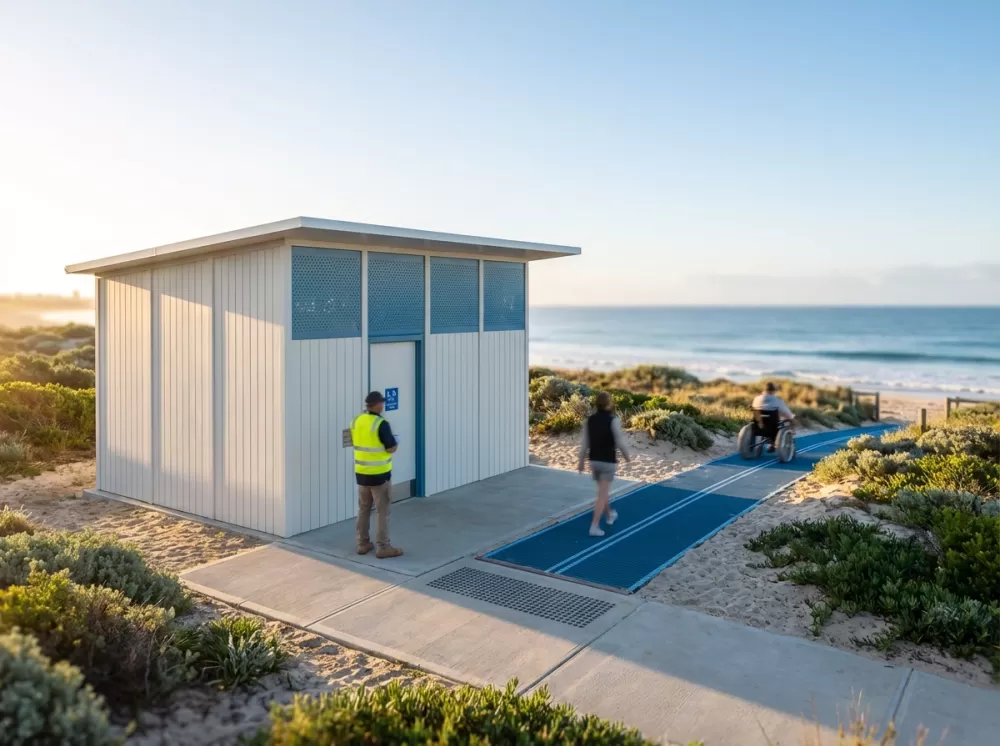
We suggested customising the Yarra 6 model. The skillion roof of the Yarra design is particularly suited to coastal climes, and it's easy to construct to standards that will endure strong wind loads, constant salt air exposure and marine environment corrosion.
Lisa Armstrong, the Acting Coordinator Property Management and Maintenance for City of Bunbury, says that off-site manufacturing delivered quality assurance and significantly reduced construction time and disruption in a heavily used public area.
"... [An] in-house design approach ensured the building integrated seamlessly with the broader foreshore landscape project while being engineered for coastal resilience - critical for this high-exposure location. The Modus team were collaborative throughout, and we now have a facility that serves our community well and is built to last in demanding coastal conditions."

Partner with experts
Coastal resilience isn't just about materials; it's about expertise. Ensure you are working with a toilet manufacturer who has a proven track record in coastal locations and can provide a specification that guarantees extended life in highly corrosive environments. Drop us a line if you're interested in finding out more about how we can help your next coastal public toilet facility last the distance.