Engineered for the Foreshore: Koombana Bay Public Amenity Building

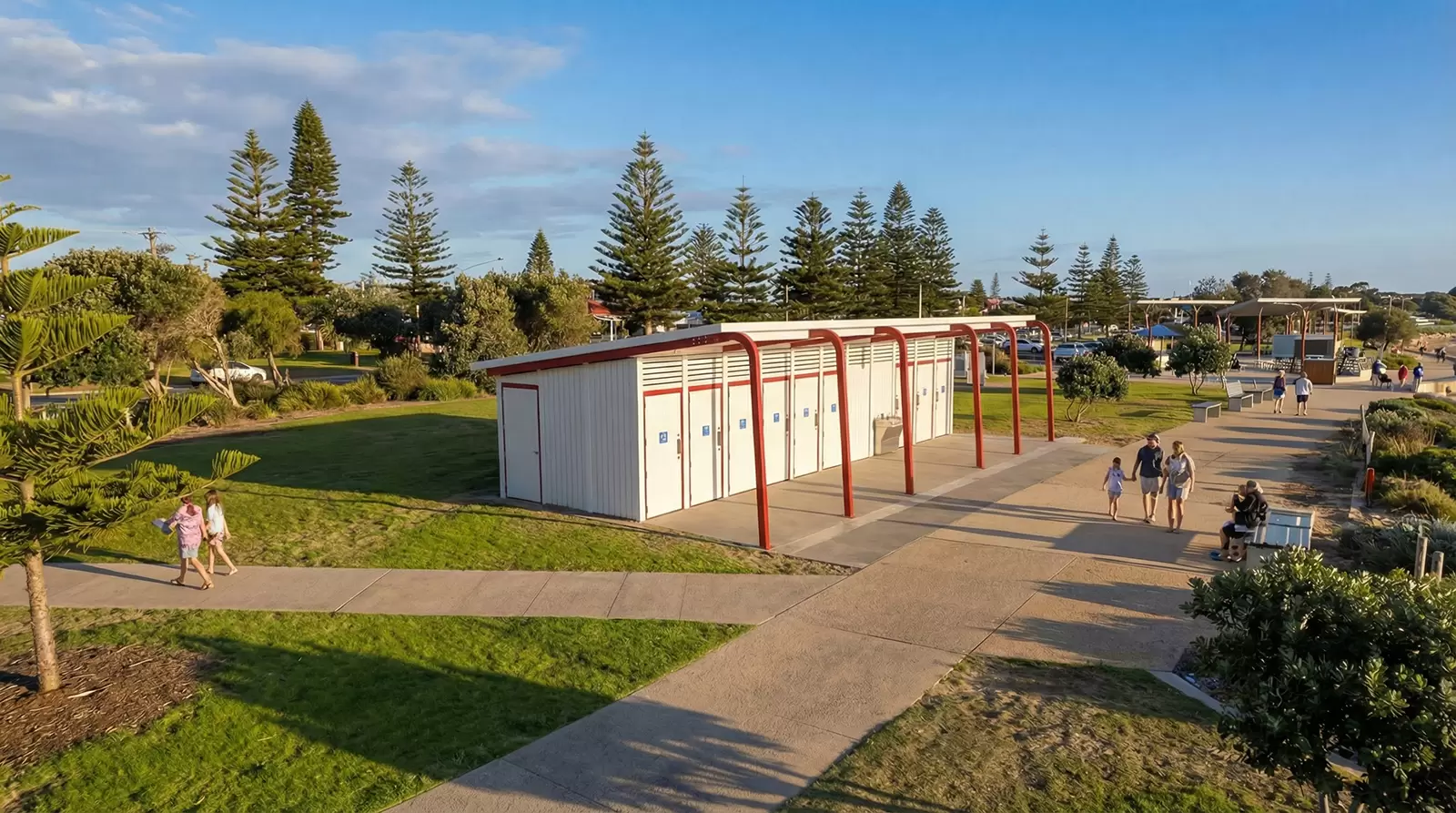
Recently Modus was involved in a developing a compliant public toilet facility solution for a high-exposure coastal location in Koombana Bay, WA, for the City of Bunbury
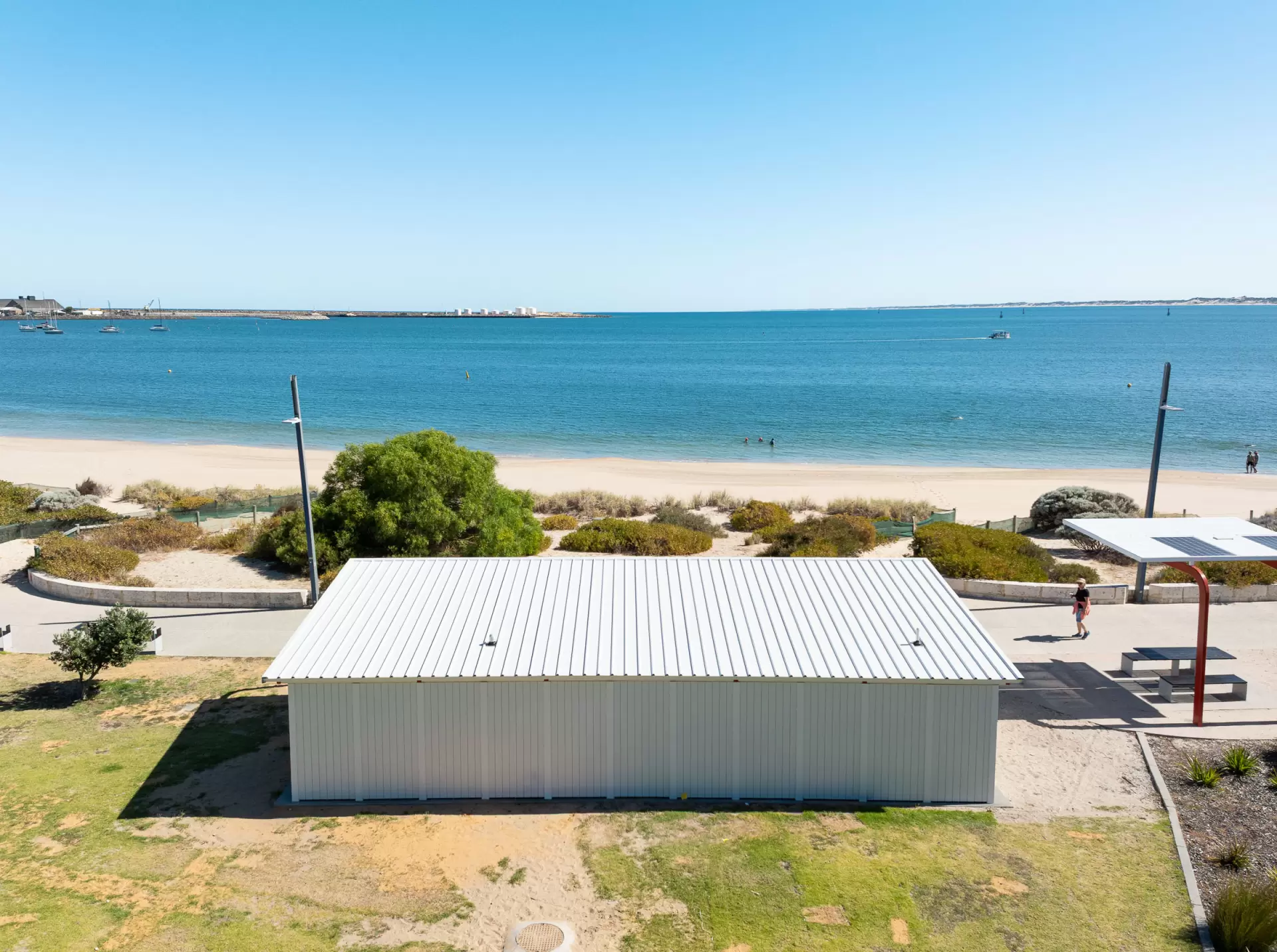
The City of Bunbury Council was carrying out a landscape redevelopment to reinvigorate the underused Koombana Bay waterfront. As part of this, they needed a durable public toilet facility that would be able to endure the harsh salt corrosion risks that come with any coastal foreshore location
We suggested customising the prefeb washrooms Yarra 6 model. Prefabricated offsite, Yarra 6 is a very versatile design with it's the skillion roof yet engineered to endure strong wind loads, constant salt air exposure and marine environment corrosion.
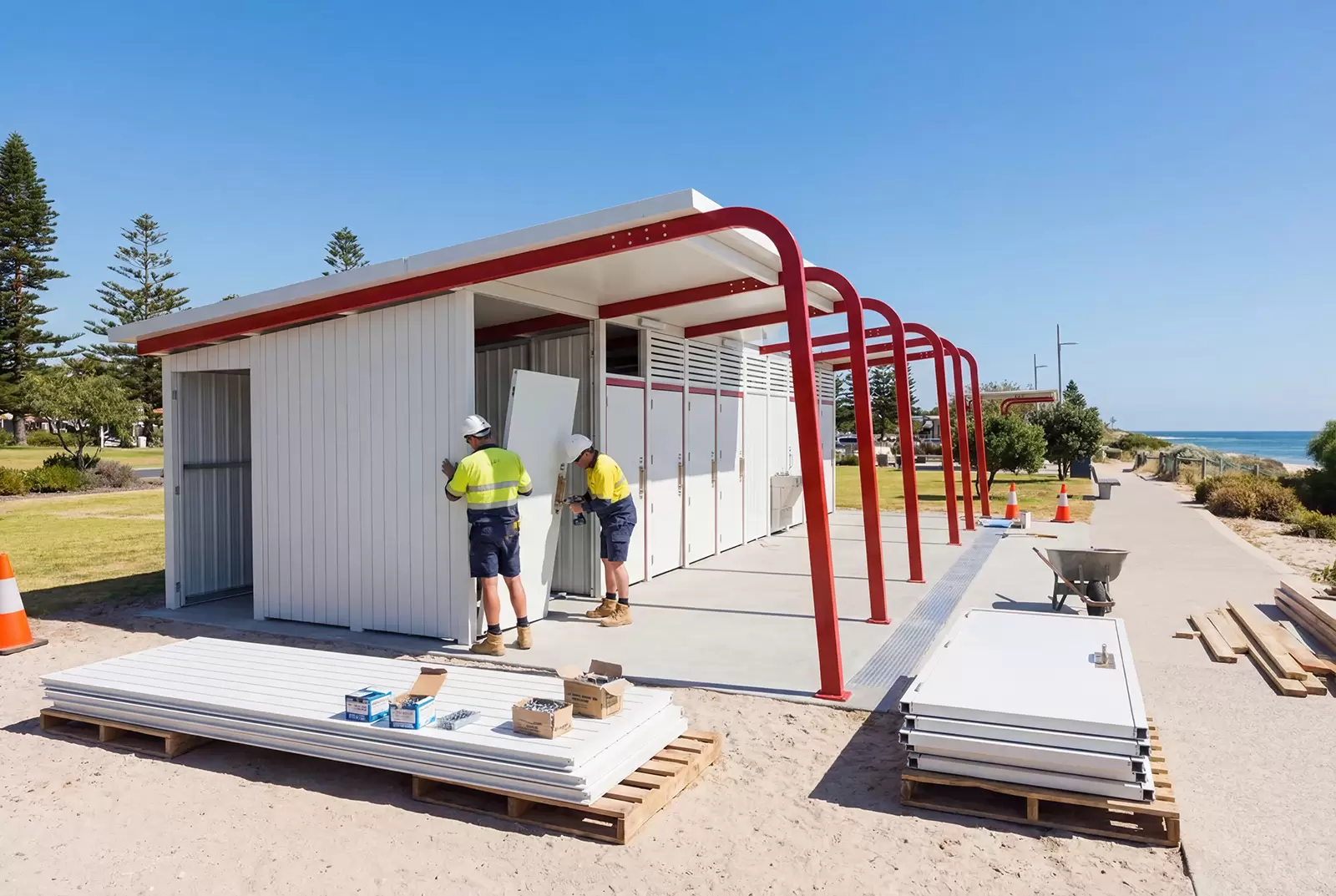
Aesthetic integration with the existing and planned infrastructure was also key, the stand out design feature being the red powder-coated verandah columns.
What was the underlying community need?
Important community needs for the popular and heavily used foreshore precinct guided the Council’s requirements and decision-making.
They needed to replace the current, aging toilet facilities with modern infrastructure that included accessible toilets, showers for beach users and which met current AS1428.1 standards. It would need to comfortably support higher visitor numbers that the Council expected once the foreshore was redeveloped. And any solution would have to be durable and low-maintenance to deliver long-term value to council and community.
What were the key challenges for constructing a toilet facility on this site?
Foremost, any toilet proposal needed to account for a coastal marine environment that meant constant exposure to salt air, high UV and wind loads, plus significant short and long-term corrosion risks. Further, City of Bunbury Council required a facility that would last at least 30 years in these harsh conditions.
At the same time, the site imposed tricky logistical and architectural challenges. The design would have to incorporate custom aesthetics suitable for the foreshore location. It also had to smoothly integrate with nearby existing shelters. Construction also needed to be coordinated with the broader ongoing foreshore renewal broader ongoing landscape project while minimising disruption to community use of the beach and foreshore.
What approach did Modus use to develop a robust public toilet amenity for this coastal location?
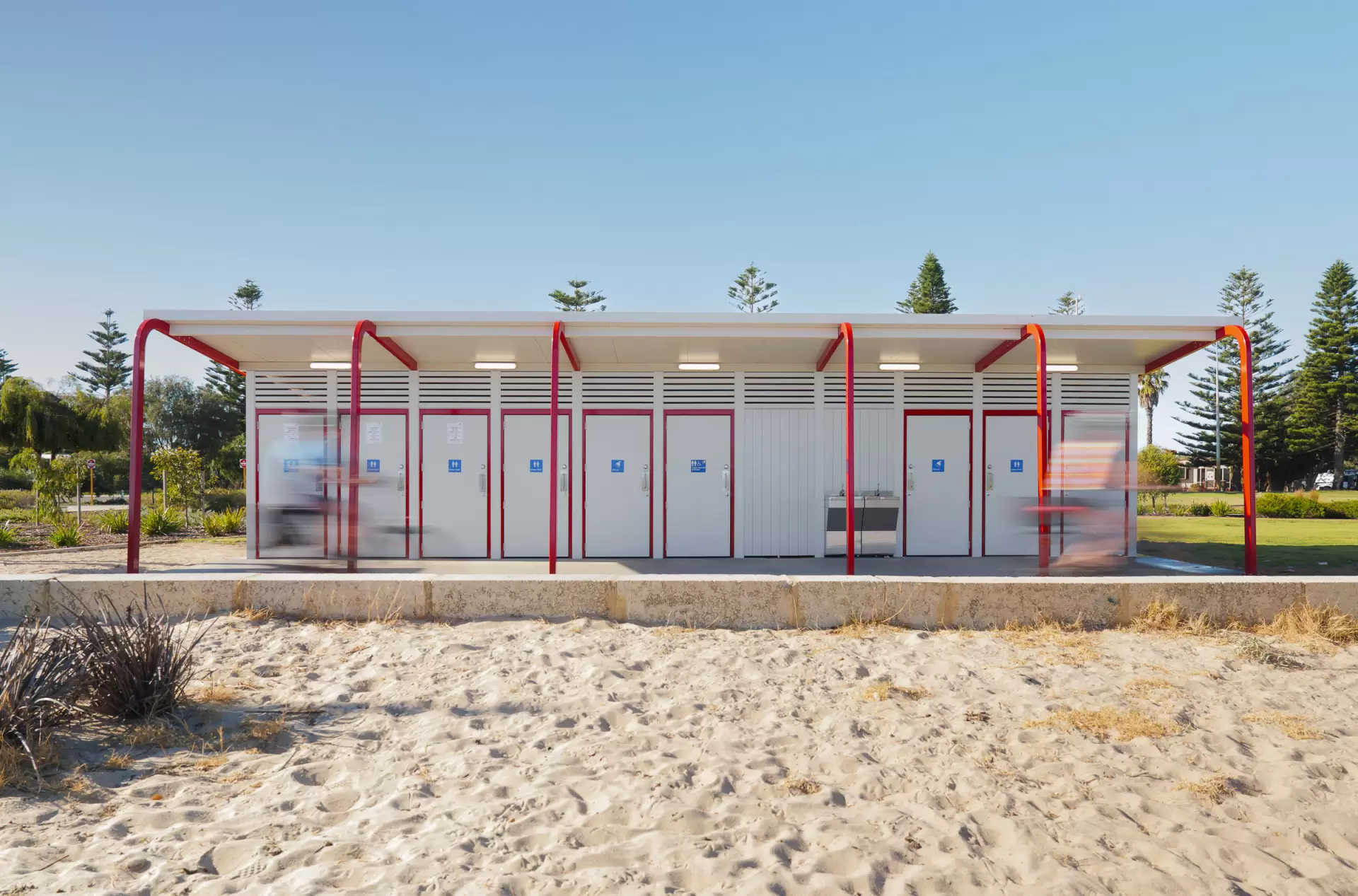
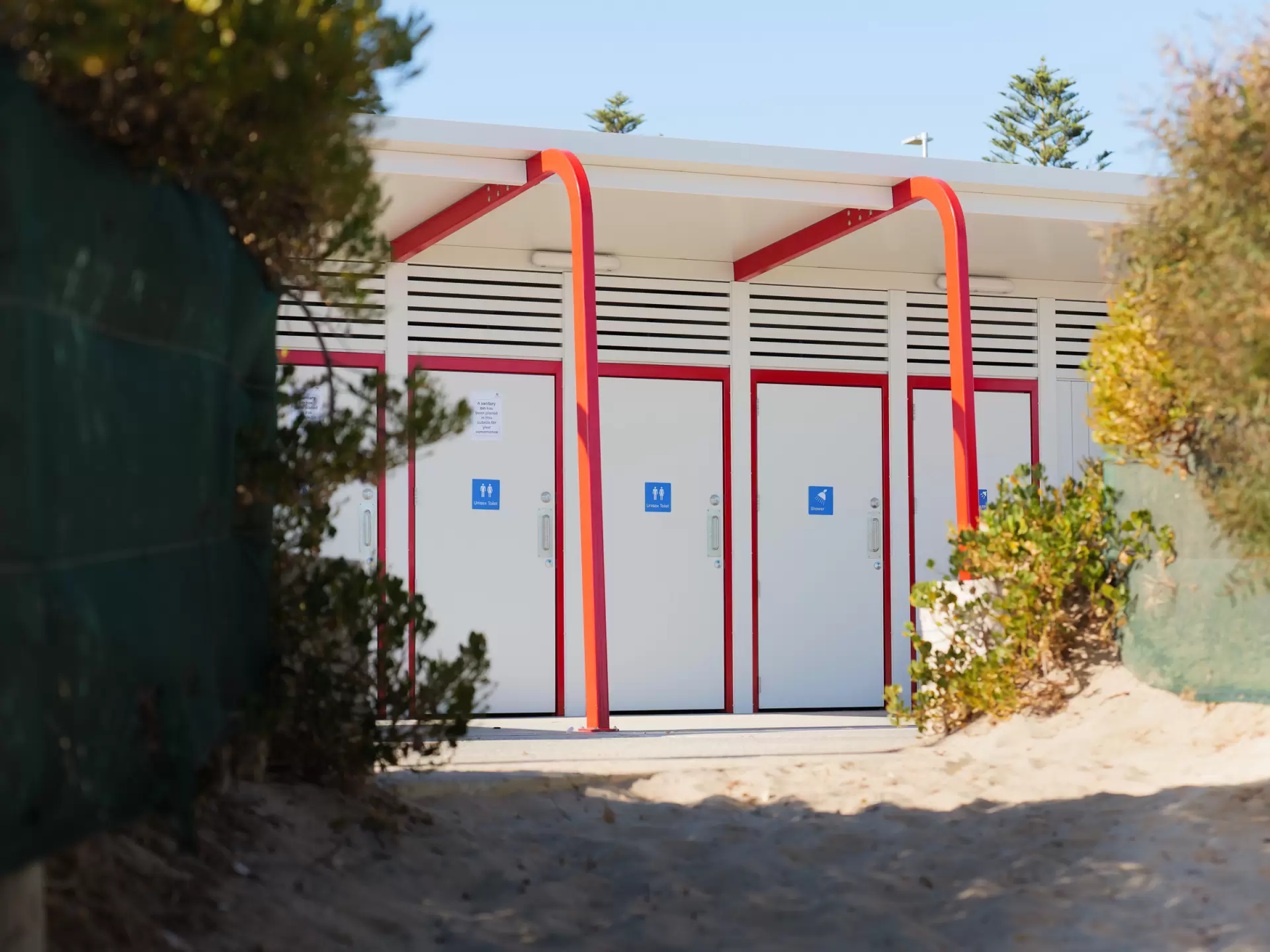
Modus’ design team settled on a on a custom configuration of the Yarra 6 public toilet design with 7 cubicles, an accessible toilet and two showers, plus a staff-only servicing area for maintenance.
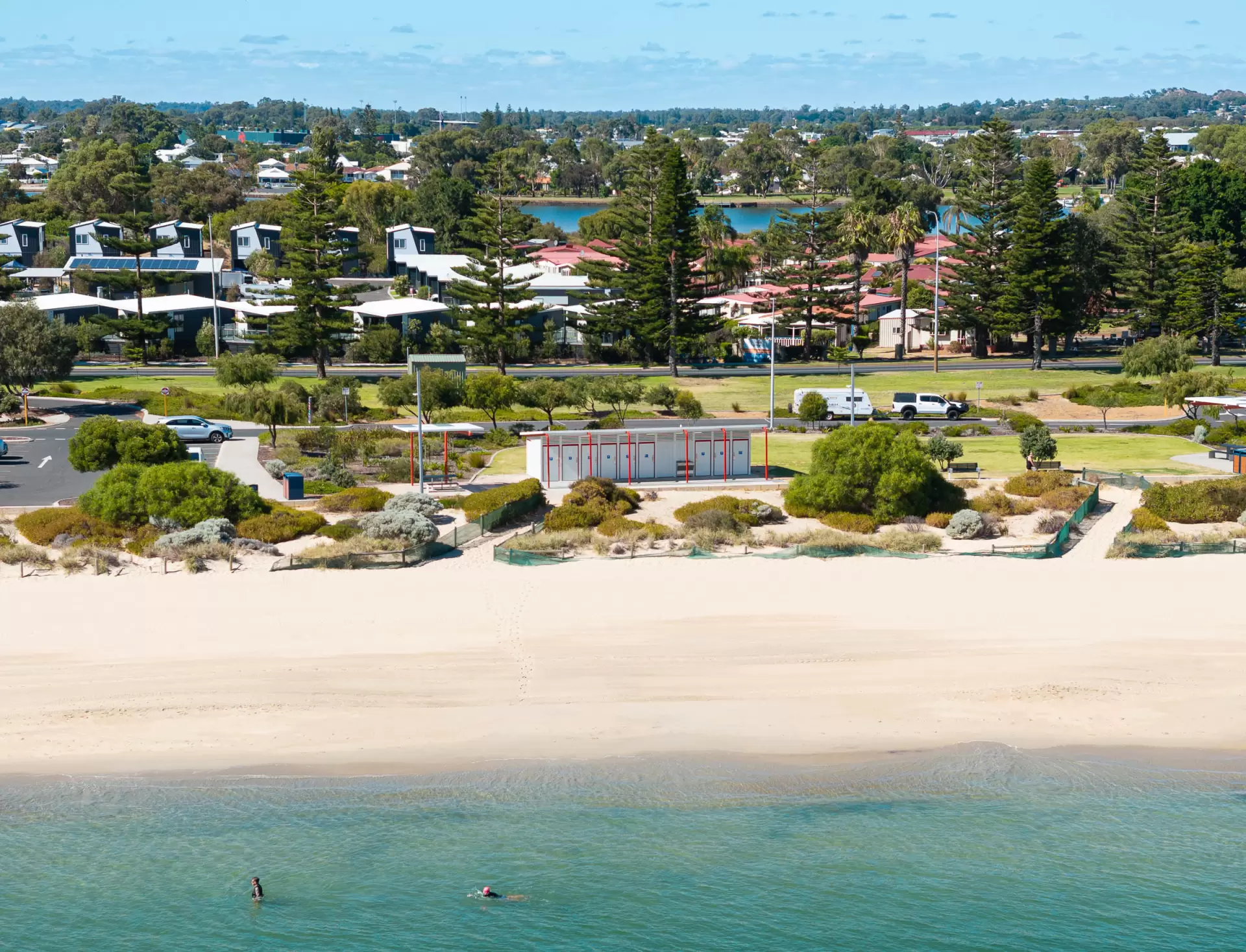
The versatile Yarra 6 would be ideal for a coastal, beachside project. Keeping the project design in-house made it simpler to align the look, functionality and style of the new 15.5 metres by 6.88 metres facility to complement the broader renewal of the Koombana Bay foreshore.
As part of this, the engineering team chose to integrate a verandah column structure with red powder-coated columns that would match existing site furniture and use Surfmist cladding and roofing finish for a clean coastal aesthetic.
How did Modus develop the facility for maximum durability and operational life?
The structure itself uses a robust combination of materials to meet the Council’s desired 30-plus-year useful operational life.
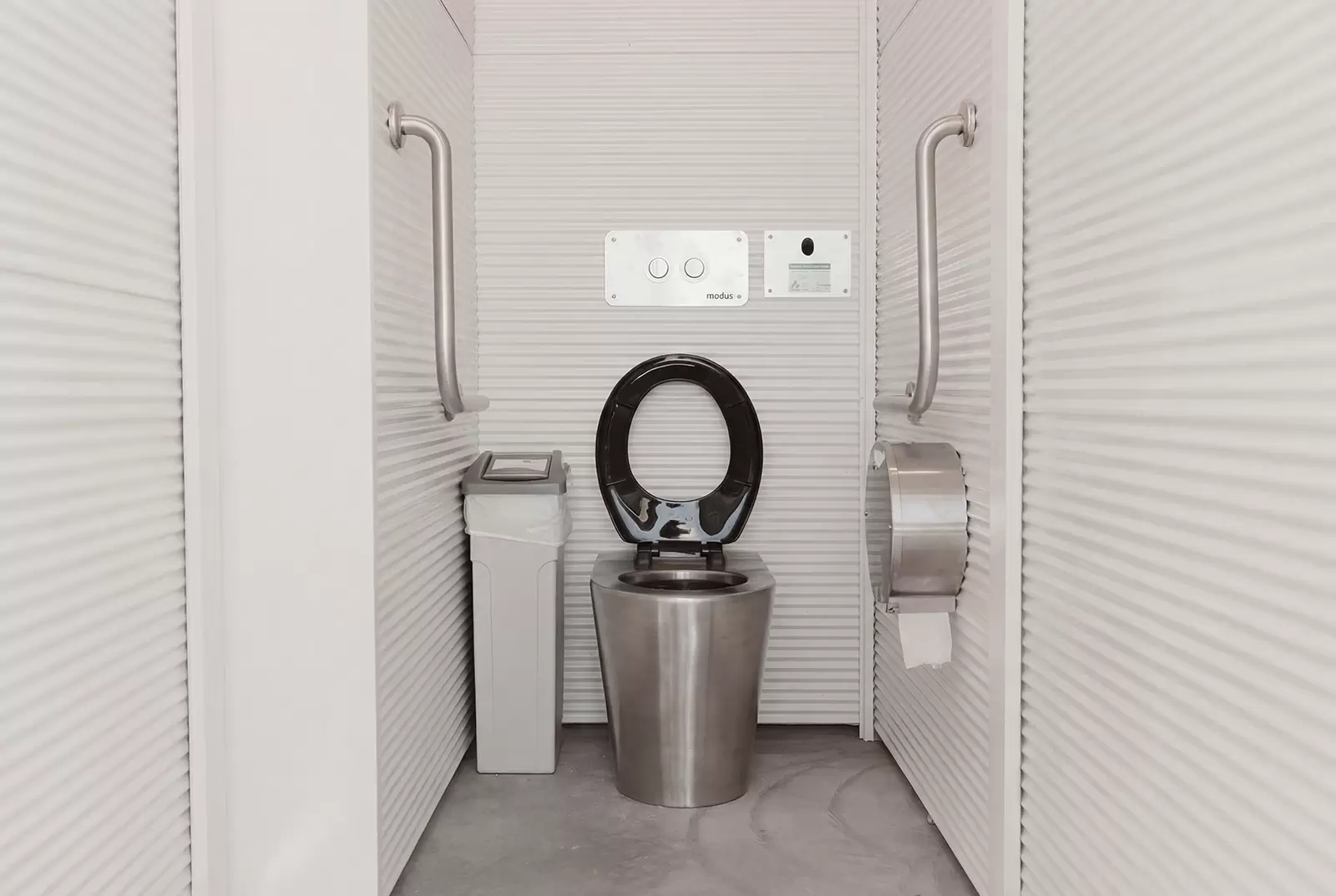
The primary frame is made from hot-dip galvanised steel. This is further protected by a 2 Pac epoxy paint system for long-lasting and effective corrosion resistance. External surfaces are all marine-grade aluminium cladding while the roofing uses Colorbond Ultra - a proprietary solution renowned for its ability to resist salt-laden air and high-moisture conditions that degrade standard building materials. Plus, all the internal fixtures — such as the 7 concealed cistern toilets, the 3 washbasins and 3 showers, as well as handrails, hinges and locks use high grade marine stainless steel for maximum durability and ease of maintenance.
Download the Complete Guide and Checklist
Ensure your public toilet project is well-planned, accessible, and built to last. Get the key steps and expert insights in one easy-to-use guide.

How did Modus approach the integration of accessibility principles and safety?
The facility is designed from the ground-up to meet AS1428.1 compliance standards and features an accessible toilet and shower. Each cubicle has ambulant grabrails; showers come with anti-ligature fixtures (and are powered by a high-capacity 3-phase Stiebel Eltron hot water system for user comfort).
Toilet Safety provisions include concealed sharps disposal units and deadlock security systems on all cubicles. LED lighting is integrated with day/night sensor and motion detection devices and is just one of the ways our engineers applied CPTED anti-vandalism principles to the toilet facility design and layout.
How did Modus approach manufacturing and installation to minimise disruption?
The project employed an off-site, prefabricated manufacturing approach for stronger control over final quality, and to minimise disruption to the foreshore surrounds. Furthermore, Modus' true modular system with internally and externally pre-clad panels as well as fully pre-hung doors. Under this system, installation becomes a simple, bolt-together process that eliminates several time-consuming steps associated with traditional 11-step flatpack assembly. Construction is as much as 30% faster, and much less disruptive.
That meant once the new concrete pad was poured and cured, the entire toilet block structure could be installed in days, significantly reducing disturbance to foreshore public access.
Full Specs of Koombana Bay Public Toilet Amenity
| Specification | Details | Additional Info |
|---|---|---|
| Building Type | Custom Yarra 6 with integrated shelter | Prefabricated coastal amenity building |
| Dimensions (approx.) | 15.5m (L) × 6.88m (W) | 7 cubicles + 1 accessible toilet + 2 showers + service area |
| Structural System | Modular prefabricated steel frame | Surface-mount installation, no cast-in columns |
| Frame Material | Hot-dip galvanised steel | Two-pack epoxy paint system |
| External Cladding | Vertical aluminium powdercoat fascia planking | Above door: Powdercoated aluminium battens |
| Verandah Columns | Custom Rounded Verandah Columns | |
| Internal Cladding | Mini Orb with impact-resistant finish | Surfmist finish, replaceable panels |
| Roofing | Colorbond Ultra (coastal grade) | Surfmist finish, integrated shelter structure |
| Door | Solid core with Colorbond metal skin | Prehung in frame with all hardware fitted |
| Door Hardware | Heavy duty marine grade stainless steel hinges, indicator bolts, door closers | Internal and external pull handles |
| Fixtures - Toilets | 6× ambulant P-trap pans S/S | 1× disabled P-trap pan S/S, concealed cisterns |
| Fixtures - Basins | 3× standard basins | Ezy Push 15-second time-flow taps (concealed) |
| Fixtures - Showers | 2× standard showers, 1× disabled shower | Anti-ligature fixtures, concealed sharps disposal |
| Accessibility Features | AS1428.1 compliant | Ambulant grabrails (2 per cubicle), handicap grabrails R.H. |
| Lighting | LED batten lights | Day/night switch with motion sensors |
| Security Hardware | Deadlocks on all cubicles | Stainless steel fixtures throughout |
| Services | 3-phase hot water unit | Stiebel Eltron 13Plus, electrical control box with MCB/RCD |
| Protective Coatings | Anti-graffiti coating option | Corrosion-resistant marine-grade finish |
| Design Life | 30+ years | Engineered for high-exposure coastal environment |
| Compliance Standards | AS1428.1, BCA compliant | Coastal specifications, CPTED principles |
| Manufacturing | Off-site prefabricated construction | 7-step modular installation system |
| Vandal Resistance | Impact-resistant internals | Replaceable cladding panels, S/S mirrors and fixtures, mini orb internals, sharps dispensers, concealed cisterns |
Community Outcomes
Bunbury residents now have a modern coastal amenity built to serve for 30+ years. Full AS1428.1 accessibility compliance means the facility is open to everyone, and the addition of showers supports greater beach use and water recreation.
For the Council, the low-maintenance design keeps ongoing costs down - impact-resistant internal surfaces and modular, replaceable cladding panels make repairs straightforward when needed. Rapid off-site installation kept disruption to the popular foreshore to a minimum.
"Working with Modus Australia on the Koombana Bay amenities building was a really positive experience. Their in-house design approach ensured the building integrated seamlessly with the broader foreshore landscape project while being engineered for coastal resilience - critical for this high-exposure location. The off-site manufacturing delivered quality assurance and significantly reduced construction time and disruption in a heavily used public area. The Modus team were collaborative throughout, and we now have a facility that serves our community well and is built to last in demanding coastal conditions."
Lisa Armstrong, Acting Coordinator Property Management and Maintenance, City of Bunbury
Frequently Asked Questions
What makes prefabricated toilet blocks suitable for coastal environments?
Keep in mind that coastal toilet blocks must be able to withstand constant salt air, high winds, and UV exposure. Not just for a few months, but for decades. All these conditions quickly corrode or degrade standard building materials.
Any solution must be inherently engineered for coastal resilience: Prefabricated toilet blocks can be specifically designed for coastal locations. Engineers can choose corrosion-resistant materials like hot-dip galvanised steel with 2 Pac epoxy paint systems, Colorbond Ultra roofing, and aluminium cladding. These materials deliver 30+ year design life even in harsh coastal conditions.
Quality control becomes critical: Any weak point or flaw in the structure immediately becomes an entry point for corrosion in a coastal situation. Where construction precision is vital, every weld, seal, and protective coating must be perfect. Prefabrication lets all this manufacture occur in a controlled factory environment where tolerances be monitored to much more exacting specifications.
The Koombana Bay advantage: We engineered the facility specifically for this high-exposure foreshore location, choosing materials and finishes that can handle salt air and coastal weather. We also made sure it meshed with the broader landscape project without compromising the structural robustness required for a waterside environment. Choices like stainless steel fixtures, impact-resistant internals, and anti-graffiti coatings on the building cladding ensure the amenity can handle both weather and high-volume public use.
How long does it take to install a prefabricated amenity building compared to traditional construction?
Prefabricated toilet amenities can be installed 30-50% faster than anything constructed using traditional methods. However, the choice of pre-fab system matters.
With a true modular prefab (7 steps), the wall panels are delivered to the site pre-clad inside and out. The doors are pre-hung. Installation then follows a streamlined process: services pre-lay → earthworks → one concrete pour → panel installation → roofing → fit-out → commissioning. There is only one concrete curing period, and no complex column work is required.
By contrast, flatpack systems (11 steps) demand two separate concrete pours, multiple curing periods, and extensive on-site assembly of frames and cladding. This is a lot slower, and more disruptive.
The real-world impact: At Koombana Bay, off-site manufacturing meant minimal disruption to the heavily used foreshore. Once the concrete pad cured, installation was finished in days rather than weeks.
The key advantage: The building frame is manufactured off site at the same time as services pre-lay and concrete pouring is happening on-site. This parallel workflow is dramatically faster. This is a crucial benefit for councils managing public spaces where construction can impose severe disruption to community amenities and services.
How much does a custom coastal amenity building cost?
Pricing reflects the specific needs of your project, and several key factors shape the overall cost.
Material selection is a primary consideration: choices such as steel versus aluminium cladding, standard versus marine-grade hardware, and the use of specialised coastal coatings affect both initial outlay as well as long-term durability and maintenance.
Building scope also plays a major role. Whether you require a standard toilet block or a multi-purpose amenity that has showers and changerooms - not to mention the size, fixture count, and compliance with accessibility standards (AS1428.1) - all affect the final figure.
Custom architecture and design adds further value but also cost. Still, tailoring a facility to integrate seamlessly with a landscape project or a specific architectural theme - such as how the Koombana Bay amenity matched the foreshore development while meeting rigorous coastal resilience requirements - ensures the structure fits its local context and is not merely a generic solution.
Finally, the delivery method affects pricing: whether you need the frame only, or require a full turnkey installation that includes siteworks, plumbing, and electrical connections are all important costing considerations.
Get accurate pricing: For a tailored quote, start a project consultation where we can discuss your site, usage requirements, and budget. You can also explore options by browsing building types or creating a custom floorplan.