The Hidden Risks in Public Toilet Projects (and How to Avoid Them)

Public toilet projects may seem straightforward, but for unwary or inexperienced council project and facility managers, they can conceal unexpected complications.
A poorly scoped brief, overlooked ground conditions, or ill-considered fixture choices can turn any toilet build into an ongoing operational liability. Most failures aren't born on site. Instead, the problems are baked in during early decisions, then amplified through procurement, construction, and handover.
When missteps occur, these compound: budget blowouts from rework, chronic maintenance and cleaning burdens, premature asset failure, an unhappy community, and political fallout.
The good news? Most failures trace back to a handful of predictable, avoidable mistakes. In this article, we walk through the six critical stages of every toilet building project. From early scoping through to long-term operation we'll highlight where decision-makers commonly go wrong, and suggest what they ought to be doing instead.
What are the common public toilet scoping and planning mistakes?
Oversights in scoping and early planning are the easiest way to fuel operational friction, create community backlash, and generate avoidable whole-of-life costs.
Skipping community consultation
A public toilet is, by definition, a building for the community. Yet councils sometimes design and install facilities without meaningful local input. Only later do they wonder why social media is lighting up with complaints. A short consultation before design begins - even a simple survey or drop-in session - can reveal concerns about location, accessibility needs, safety perceptions, and local usage patterns. It's far cheaper to move a pin on a plan than to defend (or amend) a finished toilet facility that has the very people it's made for up in arms.
Misjudging capacity needs
A second common planning mistake is misjudging capacity needs. Efficient public toilet design should account for expected user volume and peak usage times to minimise queues and congestion without overproviding. Planning a 10-cubicle block for a once-a-year event wastes scarce capital and maintenance budgets. On the other hand, a hot water system for a facility with showers that caters for only half of peak demand is going to leave a lot of users unhappy.
Capacity at remote sites
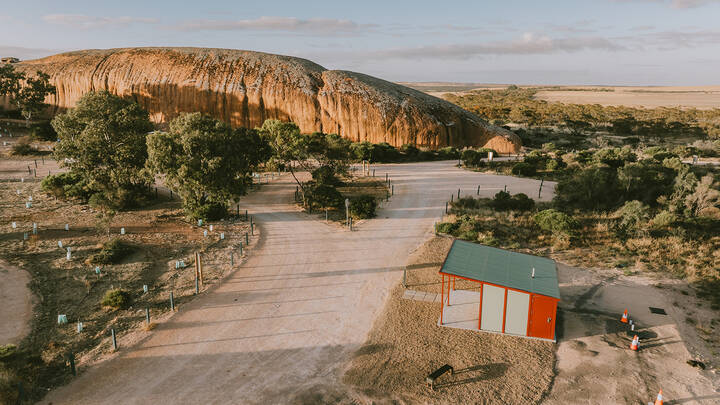
This goes double for remote sites. In remote areas where temporary portable toilets are prohibitively expensive to truck in, the installed facility must be able to carry the full load. Under sizing a waste or holding tank at these places doesn't simply cause inconvenience - it creates a service failure with no practical fallback.
Missing universal access provisions
Under current standards, the first toilet facility on a site must include universal access provisions. Some councils still default to separate male and female blocks without an accessible cubicle - not out of deliberate exclusion, but because the project team is unaware of the regulations. This is a compliance issue not a design preference, and always should be locked in at scoping stage.
Underestimating approval timelines
Remember that DA processes are a fact of life. The mistake isn't the delay itself - it's failing to account for it in your timeline. Don't let this be you! Similarly, postponing engagement with Traditional Owners until design is locked is a scheduling trap. Cultural heritage clearances can take months; early consultation prevents costly stand-downs and honours genuine partnership.
Allenby Gardens, SA, 2024 - new public toilets fitted with metal mesh doors that locals complained were see-through. Residents were left visible, and social media lit up. The exact scenario described above, in real life.
Compliance vs usability
Next, meeting minimum accessibility standards rather than aiming for best practice is a mistake. They might seem like little things, but a tight turning circle for a wheelchair, or poorly placed grab rails can trigger complaints despite being technically compliant. Separating male and female blocks while omitting universal access is equally outdated and misaligned with current code. Design for usability, not for checkboxes.
Exterior colour choices
One factor that can make a new toilet facility prone to aging quickly is choosing bright UV exterior colours - reds, blues, and yellows. These colours fade fast in Australian conditions. Yet colours that are too dark will make a facility seem scary and uninviting, especially at night. We know from experience this makes people sub-consciously reluctant to use the facility.
Why timber and tiles fail
Timber panelling and finishes will quickly warp, split, and crack. Similarly, we don't recommend using tiles in public toilets: the grout eventually becomes dirty and smelly. At that point even thorough cleaning never makes it look as good as it once did. Plus, the tiles themselves are easily broken, and the restoration and repair costs are high.
Designing for flood zones
If you've determined that your toilet is going to be in a flood zone (per our earlier Q100 point), then that will require specific engineering for flooring height, the selection of water-resistant materials, specifying a sewage safeguard system and more.
Flooring and slip ratings
Finally, flooring specifications demand precision. The wrong slip rating in a wet area invites slip-and-fall incidents, liability knowledge, and emergency closures. Specify epoxy sealed concrete (not polished) from the start and verify wet-area slip ratings against actual cleaning regimes and expected foot traffic.
What are typical site investigation mistakes that councils make with public toilets?
Wind, bushfire, and flood ratings
Every toilet site in Australia sits within a defined wind region, bushfire attack level (BAL), and flood zone. Each of these items directly affects the structural engineering, material selection, and standards compliance requirements of the facility. Wind regions C and D (cyclone-prone areas) demand specific engineering and materials to endure lateral loads because when there's enough uplift, the wind will literally rip the head from normal brass screws, and the roof sheeting will rapidly follow.
Late-surfacing BAL ratings
Q100 flood mapping reveals whether a flood event has a one percent chance of occurring in any given year at that spot. This also has substantial design implications. Bushfire BAL ratings in particular have a habit of surfacing late - sometimes after structural design has been finalised - forcing expensive re-architecture.
Confirming site services
Second, if there's no sewer, water, or mains power, the entire scope changes. We've seen projects where the nearest sewer connection was downslope from the site, requiring a pump system that hadn't been budgeted. If the project team doesn't tell you there's no sewer, you can't scope the right waste system. If there's no connection, the waste system must be designed for off-grid operation from day one. Solar and battery readiness should be evaluated early, not expensively retrofitted.
Checking existing power capacity
If there is power, confirm the existing supply is suitable for the new facility. A design that calls for additional cubicles, heated water, lighting, or sensor systems may draw more power than the site can deliver. This is a quick, low-cost step at scoping, but painfully expensive to discover during commissioning.

Overhead constraints and crane access
Before concrete hits the ground, the team needs a comprehensive services survey - including overhead constraints. Trees and powerlines can make crane-delivered modular or drop-in facilities impossible to deliver. Prefabricated construction still works in these situations, but panelised delivery and smaller crane footprints are different logistics that need planning, not improvisation.
Under-designing surface drainage
Similarly, under-designing surface drainage for the actual catchment of the toilet building is a common civil engineering mistake. Toilet blocks generate concentrated roof runoff and, in high-use facilities, significant washdown flows. If drainage design doesn't account for actual catchment area and local rainfall intensity, the result is ponding, erosion, or water ingress.
Trees and tree protection zones
Finally, on urban and peri-urban sites, existing trees can be an enormous installation constraint. Damaging a protected tree can trigger substantial fines. Where tree protection zones overlap with footprints or access routes, standard excavation may be impossible. This was the case for the facility we installed at Kwinana Adventure Park. Instead, we proceeded with careful vacuum-excavating, even engaging a certified arborist to monitor the earthworks. Check whether your project may need something similar.

Kwinana Adventure Park - 500+ existing trees preserved, the ablution block sitting comfortably within them. See the project →
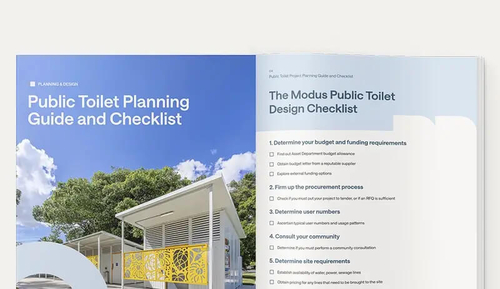
Download the Risk Audit Checklist
The 14 oversights councils most regret missing - covering site engineering, permissions, and specification. Take ten minutes at scoping or pre-tender to stress-test your next project.

What are the most common public toilet design and specification mistakes?
Design and specification decisions are effectively a 20-year operational contract.
That's why the costliest mistake is specifying to lowest upfront price, not whole of life cost.
Specifying on lowest upfront price
Cheap fixtures get destroyed. Budget materials need replacing every five years instead of every two decades. A $15,000 saving at procurement can easily become a $150,000-plus cost across 20 years decades of reactive maintenance and early replacement. Planners and architects need to evaluate whole-of-life cost - including maintenance labour, replacement cycles, and downtime - not just the sticker price. As our refurb vs replace analysis shows, believing you can simply "touch-up" an aging facility every five years or so to extend its useful life invariably costs you more over the long run.
The trap of automated systems
Fully automated self-cleaning toilet systems - the kind with rotating seats, floor-wash cycles, and automated entry doors - are sometimes marketed as a set-and-forget solution. They're not. These systems rely on proprietary parts, specialist maintenance knowledge, and complex electromechanical systems that fail in ways a standard cubicle never will. Users can get locked inside during system errors. Electronic failures can take a unit offline for days while replacement parts are sourced - in some cases from overseas manufacturers - and installed by expensive-to-hire specialised technicians.
Marketing claims vs reality
If a council is considering an automated solution, the business case must scrutinise the true maintenance cost - not just the aspiration. It's also worth noting that sensor taps and push-button doors are frequently marketed as "automated," but they are not self-cleaning. Some suppliers blur this line in digital marketing. The guideline is to clarify operational expectations early and verify local serviceability before making any commitments.

Ararat Rural City Council replaced their automated Exeloo with the Modus InCube 1 after repeated motherboard failures turned a high-tech solution into an ongoing maintenance drain. See the project →
Compliance vs usability
Next, meeting minimum accessibility standards rather than aiming for best practice is a mistake. They might seem like little things, but a tight turning circle for a wheelchair, or poorly placed grab rails can trigger complaints despite being technically compliant. Separating male and female blocks while omitting universal access is equally outdated and misaligned with current code. Design for usability, not for checkboxes.
Exterior colour choices
One factor that can make a new toilet facility prone to aging quickly is choosing bright UV exterior colours - reds, blues, and yellows. These colours fade fast in Australian conditions. Yet colours that are too dark will make a facility seem scary and uninviting, especially at night. We know from experience this makes people sub-consciously reluctant to use the toilet facility.
Why timber and tiles fail
Timber panelling and finishes will quickly warp, split, and crack. Similarly, we don't recommend using tiles in public toilets: the grout eventually becomes dirty and smelly. At that point even thorough cleaning never makes it look as good as it once did. Plus, the tiles themselves are easily broken, and the restoration and repair costs are high.
Designing for flood zones
If you've determined that your toilet is going to be in a flood zone (per our earlier Q100 point), then that will require specific engineering for flooring height, the selection of water-resistant materials, specifying a sewage safeguard system and more.
Flooring and slip ratings
Finally, flooring specifications demand precision. The wrong slip rating in a wet area invites slip-and-fall incidents, liability claims, and emergency closures. Specify epoxy sealed concrete (not polished) from the start and verify wet-area slip ratings against actual cleaning regimes and expected foot traffic.

AS1428.1 insists on a 1400mm floor exclusion zone around the pan.
What are the most common public toilet procurement mistakes?
Awarding to the lowest tender
Awarding to the lowest tender is something we see continually.
This is a false economy because when value engineering is pushed too hard, you strip out the essential durability, serviceability, and compliance. The result is a facility that looks and performs like it was assembled with a hacksaw. It looks bad, it's not really usable, and it ends up costing you more than you expected. Proper due diligence must evaluate how a proposal actually meets your brief and serves the community; not just how much it comes in underbudget. Price remains an important point, but cheap is no good if your facility is fundamentally not fit for purpose.
Scope exclusions and budget blowouts
Budget blowouts rarely come from the headline build cost. They come from what's excluded. Services connections, civil works, authority fees, and site logistics are frequently omitted from base tenders, surfacing only post-award. A 5% contingency is inadequate for traditional public builds. Realistic procurement budgets must factor in full-scope delivery, not just the shell.
Aligning with grant priorities
Many public toilet projects are funded - in whole or in part - through grants. The quality of the grant submission directly affects the outcome. Submissions that don't align with a grant program's stated priorities fail, regardless of the project's merit. This is an area where specialist input pays for itself: a well-prepared submission that clearly connects the project to the grant's objectives stands a significantly better chance of success. The better suppliers of public toilets will be able to help you identify and articulate the project benefits in grant-aligned language, and can refer you to a specialist grant writer if needed.

What are the most common public toilet construction and handover mistakes?
Construction is where your design intent meets execution. Without tight oversight and clear accountability, even well-scoped projects unravel during the building and install process.
Fragmented accountability in traditional builds
Traditional builds fragment responsibility across multiple trades. Each trade is responsible for their own patch. Sometimes this means that quality fluctuates, and when defects emerge accountability diffuses. No single party is accountable for the finished product as a whole.
Single-point accountability with prefab
This is where prefabricated delivery earns its keep: factory-controlled manufacturing conditions, pre-integrated systems, and a single point of responsibility eliminate the blame game and deliver predictable quality. Project and asset managers should not underestimate the benefits that this certainty delivers.
A timelapse video showing our prefab modular construction process - pre-integrated systems, and the single point of responsibility described above. See how it works →
Installation errors that void compliance
A facility can also be fully AS 1428 compliant on paper and fail at handover due to minor installation errors. Items "as small as" misplaced grab rails, incorrect door clearances, or a toilet roll holder mounted 50mm out of position will instantly void compliance. This is why detailed, trade-specific installation guides aren't administrative extras - they're critical safeguards. Good manufacturers embed them into every package to ensure certification first time.
Interstate plumbing code variations
Interstate projects frequently stumble on plumbing code variations. What's standard in one jurisdiction may breach another's requirements. Verify local amendments early and brief installers accordingly.
Operational details at handover
Handover readiness also hinges on little operational details. For example, sites relying on tank or recycled water require clear potable versus non-potable signage to meet health regulations and prevent public misuse. This is why we supply compliant signage as standard, to ensure there's no last-minute dramas.
What are the most common public toilet operational and whole-of-life mistakes?
Handover isn't the finish line. It's the start of a 20-year operational reality. How a facility performs, maintains, and survives extreme events determines its true cost to council and value to the community.
When traditional builds get hit
The biggest whole-of-life test comes when things go completely wrong. When a vehicle strikes a traditional brick public toilet, a council suddenly faces structural assessments, demolition, and a full rebuild. The same goes for floods or even significant acts of vandalism.
How modular bounces back
When the same thing happens to a modern, modular toilet facility, damaged panels are unbolted, swapped, and the asset is back in service within days. Designing for component replaceability dramatically reduces downtime, insurance claims, and lifecycle expenditure.

Taree, NSW, May 2025 - the masonry block at Winham Brush was destroyed and buried in sediment. The Modus prefabricated building nearby stayed anchored and reopened after a professional clean.
The three things to nail when procuring, designing, and installing a public toilet building
After mapping where public toilet projects commonly derail, reliable delivery comes down to three things. Get these right before approving any brief, tender, or contract, and you'll prevent entire clusters of costly mistakes.
- Specify on 20-year cost, not 20-month cost. Anchor every decision in total cost of ownership: construction, maintenance, cleaning, repairs, and component replacement. The cheapest tender almost always becomes the most expensive building. When lifecycle cost drives the brief, durability wins and operating budgets stop bleeding.
- Engineer for the site you actually have, not the site on the plan. Verify wind region, flood levels, BAL rating, soil class, services, and physical access before design is finalised. A toilet block engineered for Region B that lands in Region C won't survive its first cyclone. Assumptions will never win an argument with physics.
- Procure for single-point accountability. Ensure one party holds responsibility for design, engineering, manufacture, and warranty. This doesn't rule out supporting local trades - a two-contract model (manufacturer plus local installer) works seamlessly when responsibilities are clear. The real trap is fragmentation: multiple architects, disconnected consultants, and a builder who can point fingers elsewhere when something fails. Clear accountability prevents the blame game and is the best guarantee a compliant, operational asset on day one.
Public toilets are high-use, high-visibility assets. The mistakes are predictable. So are the solutions. Get the scoping, site intelligence, and procurement model right, and you'll deliver facilities that serve your community, withstand the environment, and are kind to the council budget for not just years, but decades.